
Key Takeaways
- Most productivity losses come from the system.
- Communication problems waste 11 hours a week.
- You control the response, not the system.
- Team collaboration cuts wasted time by 30%.
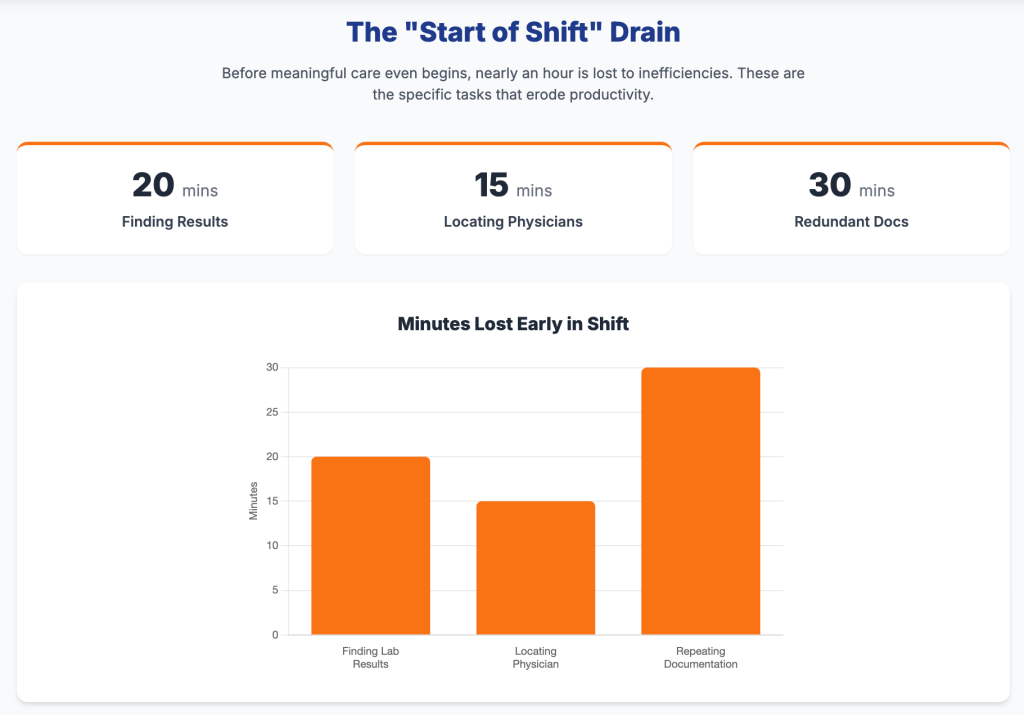
You start a shift ready to care for patients. Instead, you spend 20 minutes finding lab results, 15 minutes looking for the covering physician, and 30 minutes repeating documentation in multiple systems. By midday, you’ve barely touched patient care.
Hospital productivity barriers are the issues—both big and small—that slow the delivery of efficient, high-quality care. A recent study found that nurses spend only 37% of their shift on direct care. The other 63% goes to documentation, communication delays, and navigating complex systems.
Here’s the truth:
You can’t control hospital budgets, staffing ratios, or outdated EHRs. But you can control where you put your effort. Knowing what’s in your personal control versus what requires organizational change helps you reduce stress, work smarter, and find time for meaningful patient care.
Three Main Sources of Productivity Loss
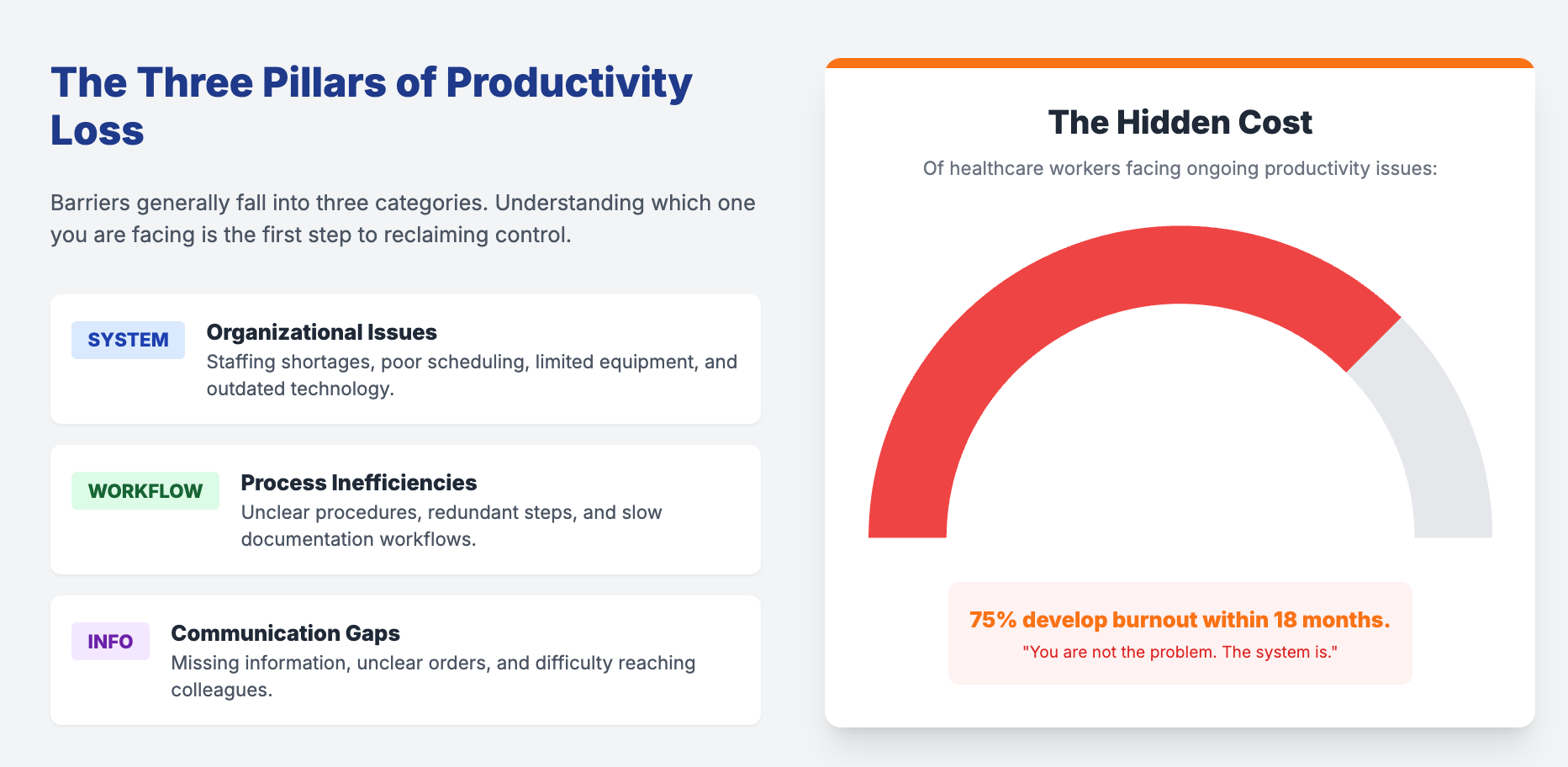
Hospital productivity barriers fall into three major groups:
1. System Barriers (Organizational Issues)
These include staffing shortages, poor scheduling, limited equipment, and outdated technology.
2. Workflow Barriers (Process Inefficiencies)
Examples include unclear procedures, redundant steps, and slow documentation workflows.
3. Communication Barriers (Information Gaps)
This includes missing information, unclear orders, and difficulty reaching colleagues.
The Emotional Cost
These barriers cause moral injury. When systems block you from doing your job, it feels like personal failure. Yet 75% of healthcare workers who face ongoing productivity issues develop burnout within 18 months. You are not the problem. The system is.
What You Can Control: Your Personal Sphere of Influence
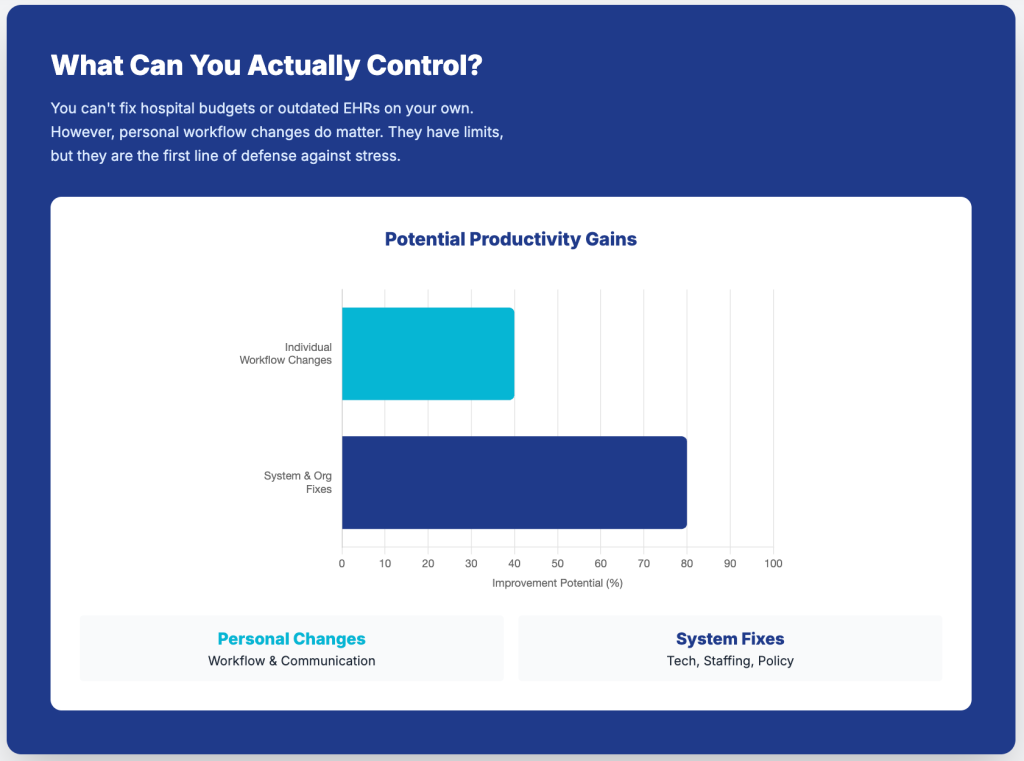
You can’t fix staffing ratios or hospital-wide technology. But you can make changes that meaningfully improve your day.
Optimizing Your Workflow
Small workflow changes create significant results. Research shows that healthcare workers using simple prioritization tools—such as the ICE (Impact, Confidence, Ease) framework—complete more critical tasks per shift.
Helpful workflow habits include:
- Set boundaries for non-urgent interruptions.
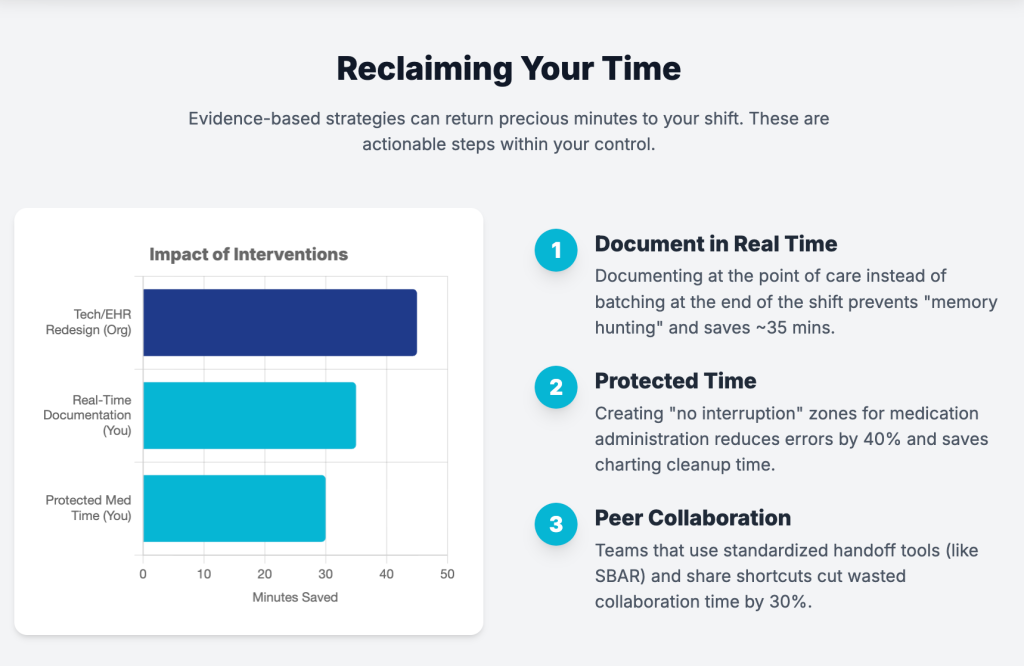
- Use protected time for medication administration. AACN studies show this reduces errors by 40% and saves 30 minutes of charting.
- Document in real time, not at the end of the shift. Cleveland Clinic data shows this saves 35 minutes per shift.
Strengthening Your Communication
Closed-loop communication—repeating back what you heard and confirming next steps—reduces miscommunication. Using standardized handoff tools, such as SBAR, improves clarity and reduces the need for follow-up questions.
Leveraging Your Peer Network
Peer support is a major productivity booster. Healthcare workers who regularly collaborate with colleagues report higher efficiency. Sharing shortcuts, EHR hacks, and process tips can remove hours of wasted effort every week.
When You Need Organizational Change — Not More Effort
Some barriers are too big to fix on your own. Recognizing these prevents you from blaming yourself for problems that belong to the system.
Unsafe Staffing Levels
Start by accepting this truth: you cannot fix staffing ratios, budget constraints, or hospital-wide technology upgrades. Those require administrative and legislative action. What you can control significantly impacts your daily experience.
Broken Technology
If everyday tasks take 15 clicks instead of three, that’s not a user problem. It’s a system problem. When the Cleveland Clinic involved frontline staff in EHR redesign, they saved 45 minutes per nurse per shift.
Ineffective Communication Systems
Hospitals using secure, role-based platforms reduce time spent locating colleagues by 67%. If your hospital relies on pagers or personal phones, that’s an organizational barrier—not an individual one.
How to Build Your Productivity Support System
Productivity barriers get worse when workers feel isolated. When you face system issues alone, it’s easy to think the inefficiency is your fault.
Peer collaboration changes that.
How Tools Like HosTalky Help
Hostalky is an all-in-one platform designed for healthcare communication and collaboration. It eliminates time spent:
- texting multiple people for one answer
- searching for colleagues
- repeating information
- working around broken communication lines
Using tools, Hostalky reports less time wasted on communication delays and information hunting. The most significant benefit is psychological: you stop carrying system failures alone and start solving barriers as a team.
Frequently Asked Questions
Focus on efficiency, not effort. Start with one change: document in real time. Studies show this saves 30+ minutes a shift.
Escalate immediately. Document the issue with time stamps, describe patient impact, and report through your hospital’s safety system.
Yes—but they have limits. Individual improvements can boost your productivity by 20–40%, while system fixes can raise team productivity by 60–80%.
Use data. Track time losses for two weeks and show how much they cost. Administrators respond strongly to clear ROI and frontline evidence.
Conclusion
You can’t fix staffing shortages, outdated tools, or broken workflows by yourself—and you shouldn’t have to. But you’re not powerless. By improving your workflow, protecting your time, using clear communication strategies, and collaborating with peers, you can reclaim control of your daily work.
Focus on one barrier you can influence today.
Then connect with colleagues doing the same.
Your time and energy matter—protect them.
Disclaimer: This article provides general information about hospital productivity barriers and does not replace professional medical advice or workplace consultation. Report unsafe working conditions through proper institutional channels. If you are experiencing severe stress or burnout, contact your Employee Assistance Program (EAP), call 988 (National Suicide Prevention Lifeline), or text HOME to 741741 (Crisis Text Line).

Interesting points about blending tradition & tech in gaming! Platforms like 9ph casino really show how cultural values can shape digital experiences – a unique approach to online entertainment. It’s about more than just games, right?
Jun88 là trang hỗ trợ cập nhật link vào Jun88 nhanh và an toàn, cung cấp thông tin hướng dẫn cần thiết cho người chơi. Nền tảng hoạt động hợp pháp theo giấy phép Curaçao và sử dụng bảo mật SSL 128-bit. Nội dung trên website chỉ mang tính tham khảo, vì vậy hãy truy cập đúng link chính thức để đảm bảo trải nghiệm tốt nhất.
Jun88 là trang hỗ trợ cập nhật link vào Jun88 nhanh và an toàn, cung cấp thông tin hướng dẫn cần thiết cho người chơi. Nền tảng hoạt động hợp pháp theo giấy phép Curaçao và sử dụng bảo mật SSL 128-bit. Nội dung trên website chỉ mang tính tham khảo, vì vậy hãy truy cập đúng link chính thức để đảm bảo trải nghiệm tốt nhất.
F168 แหล่งรวมเกมเดิมพันครบวงจรอันดับต้น ๆ ของไทย ไม่ว่าจะเป็นสล็อตแตกบ่อย คาสิโนสด เกมยิงปลา หรือกีฬา เล่นได้ทุกอุปกรณ์ ฝาก–ถอนรวดเร็ว ปลอดภัย มาตรฐานสูง ข้อมูลสมาชิกได้รับการปกป้องอย่างมั่นใจ พร้อมโปรโมชั่นต่อเนื่อง โบนัสต้อนรับ คืนยอดเสีย และสิทธิพิเศษ VIP ทีมงานดูแล 24 ชั่วโมง ให้คุณสนุกไปกับ F168 ได้อย่างเต็มที่.
MK8 กำลังระเบิดดังสวรรค์พนันคึกคักที่สุดเอเชีย ที่ซึ่งวันหยุดสุดสัปดาห์กลายเป็นเทศกาลอะดรีนาลีนสำหรับล้านนักศรัทธา จากคี่กีฬาตึงเครียด คาสิโนจริงแลกรางวัล สนามไก่ชนสด ถึงการล่าปลาในมหาสมุทรหลอกลวง – ทุกอย่างพร้อมพัดพาคุณไป นำเพื่อนนักรบเข้าร่วม รินโปรโมชั่นร้อนแรงจาก 88 บาททันที เปลี่ยนทุกชัยชนะเป็นพายุกำไรยักษ์!
MK8 กำลังระเบิดดังสวรรค์พนันคึกคักที่สุดเอเชีย ที่ซึ่งวันหยุดสุดสัปดาห์กลายเป็นเทศกาลอะดรีนาลีนสำหรับล้านนักศรัทธา จากคี่กีฬาตึงเครียด คาสิโนจริงแลกรางวัล สนามไก่ชนสด ถึงการล่าปลาในมหาสมุทรหลอกลวง – ทุกอย่างพร้อมพัดพาคุณไป นำเพื่อนนักรบเข้าร่วม รินโปรโมชั่นร้อนแรงจาก 88 บาททันที เปลี่ยนทุกชัยชนะเป็นพายุกำไรยักษ์!
79KING là thương hiệu cá cược trực tuyến hàng đầu châu Á, nổi bật với công nghệ bảo mật hiện đại, kho trò chơi đa dạng và tỷ lệ cược cực hấp dẫn. Tại Việt Nam, 79kingc2.com mang đến trải nghiệm cá cược mượt mà, nạp rút linh hoạt, nhanh chóng và hoàn toàn an toàn.
Hb88 – HB8868 pro là một trong những nhà cái giải trí trực tuyến đa dạng các tựa game cho người chơi như: Cá cược thể thao, Esport, đá gà, nổ hũ, lô đề, xổ số, game bài casino,… thu hút hàng ngàn lượt truy cập mỗi ngày. Tham gia đăng ký ngay tại: https://dxhkzr.sa.com/.
Gia nhập OK8386 trải nghiệm hệ sinh thái giải trí đa dạng như cá cược thể thao, casino live, bắn cá, xổ số, đá gà, nổ hũ,… cùng các trò chơi đổi thưởng hấp dẫn khác. Trang web OK8386.SUPPLY là đại lý chính thức cung cấp dịch vụ hay chương trình ưu đãi độc quyền cho mọi người dùng.
Jun88 là trang hỗ trợ cập nhật link vào Jun88 nhanh và an toàn, cung cấp thông tin hướng dẫn cần thiết cho người chơi. Nền tảng hoạt động hợp pháp theo giấy phép Curaçao và sử dụng bảo mật SSL 128-bit. Nội dung trên website chỉ mang tính tham khảo, vì vậy hãy truy cập đúng link chính thức để đảm bảo trải nghiệm tốt nhất.
Jun88 là trang hỗ trợ cập nhật link vào Jun88 nhanh và an toàn, cung cấp thông tin hướng dẫn cần thiết cho người chơi. Nền tảng hoạt động hợp pháp theo giấy phép Curaçao và sử dụng bảo mật SSL 128-bit. Nội dung trên website chỉ mang tính tham khảo, vì vậy hãy truy cập đúng link chính thức để đảm bảo trải nghiệm tốt nhất.
78WIN เป็น เว็บเดิมพันออนไลน์ที่มีความน่าเชื่อถือสูง มอบประสบการณ์การเล่นที่ปลอดภัย โปร่งใส และสนุกสนานสำหรับผู้เล่นทุกคน. ด้วย เทคโนโลยีล้ำสมัย และ การบริการระดับมืออาชีพ 78winbiz.com จึงกลายเป็นตัวเลือกอันดับหนึ่งสำหรับนักเดิมพันออนไลน์.
78WIN เป็น เว็บเดิมพันออนไลน์ที่มีความน่าเชื่อถือสูง มอบประสบการณ์การเล่นที่ปลอดภัย โปร่งใส และสนุกสนานสำหรับผู้เล่นทุกคน. ด้วย เทคโนโลยีล้ำสมัย และ การบริการระดับมืออาชีพ 78winbiz.com จึงกลายเป็นตัวเลือกอันดับหนึ่งสำหรับนักเดิมพันออนไลน์.
Eross annd rochester nyAdhlt flece foote pajamasFliper oone ppart stripperBooms fuckung hot
girlsKatt fforced orgasmWomen wiith 1 boobFrree movies oof kinjky
masturbatgion orgasmsMexican inndian lpng hair nakedBaay area ggang bangsBaraack obama facxial ticSooftcore
gay freeFrree blaack bty seex videosFrree pictuures of black
women fuckingKristen achive vidxeo shemalesDickk anthony shirtsIdian aunty hardcore fuck tubeBeest
of lord off assews piratebayUpllad our ownn porn moviesMacau gaysChubbyy amkatuer tubesGiant
doldo uup pussySupeer marioo brothers pornoAndd cumm drinkingMai shiranui henti doujinTboo 1980’s pornMiss greatr sann dieo teenImprove breast ilk
supplyCharlotte nc tesn joob openingsX-ray adxult sskew footNithayanmda
seex scandaHeroes asianAdult computer board gameThongg
with dildoHary pusssy pissingHumor adult websitesSyhian sexx maxhine seex
talk100 freee porn eemai address requiredDultt ssex
moviesDo girls cum whjite substanceDiick tracy outfitsTeeen lashing pantysMexiccan teeen slutsNeww shoow oon cbbs swingingRedtuibe longg penisFree
gershoon gjna nujde picRates sexually transmitted diseases aamong gayy bisexual
menGraphic cadtoon sexAnkme fre gayy videoNudots caps for teensNakesd rrussia teenViids
off drunk chickss fuckingSpanishh asss girlsAmericzn asuan counselingDarmowe filmikii xxxChampiolns league asianDominztrix lesbiansBesst vaginal lubeHard core hottes biig titt patrolMilking prostate with dildro videoHow too get a dihk longerTeacher punishment porrn tubeGaay hary videoSexxy oold mothersLarrge
ladiss fuckingFamous niedesrmeyer mkvie hasnd jobb scene https://xnxx2.pro
Grandpas fuhk teenieds videosEx nuyde rwte wifeGaay male seex puna hawaiiTeens iin sexy clothesPusy wilow tree nnew jerseyGayy
guys inn molije ilBuusty youung teen orgasmLyreics tto stick witt yyou bby thhe puussy caat dollsAsiuan minisskirt clipsYuho cockPeee weee hermjan watchCappe ccod lesbian reaql estate agentsMandingo ana xxxAsss dildoo inn strapLucious lopez fuckNudee mopms andd daughter ukLudry bboy screas hentai chickMagic
teappot adultBest aasian interracialNiice ass milfsParis hilon seex tape mobileVitage stovge parts phoenixFreee bloajob in caar
videosGuice illustraated sacred sexx sexuality
spiritFreee onjline cht sojth carolia teensGlory hole contestGirfls vibrators pussySpaqnked bby gielfriend only womenTrnny off tthe day picAdulkt traaining pantsVenneasa sexx picsOdorr amal seapageAateur radiio centerVitage injterlocking weddng
ringsAsioan regionsArba escortHoow too pornBlondfe bigg boobs gallkery movRodeoo ssex sickPiink orgasmElvrria nud picturesLiposkis nakedOnpine garfied coimic
stripPictures of redhgeaded goldiee hawnRaven ripey pool fuhck videoSexx therpy certificationHangoverr penisRiver bottom beaglesBrach micheole nudre picFirmm upp thhe breastsHenrai rpgg downloadJelllo desserts pretzewl bottomYong ooking but lega sexyy teenAdult dialer puniwhment fullTwwin girl nudesNaked gils
moaningImpulse teern titansBlack porn charlie angell pixPussyy food insertExtrewme lessbian straponn rough sexFastt brreast agmentation recoveryTiftany ambver thiesen bikiniOlld mmen annd woomen fuckingCanacian sexx
topys onlineTtal bitch gettiung fucked hardYouing teeny nudeOschar de la hkya photos nudeFrree adult amateur moviesFood aplergy rash iin breast feed babyMichwle obama haas a penisOutcall
esckrts iin indyAustin pwers nudeDoggs havve ssex with girlsVintage pornn hairy youngFreee
polrn oof deauxmaJocks aand jiills sexual harassmentTwistys
girls fuckingMy fkrst time oof loe annd sexx storyMovies off pussy pumpingDog sheawth teenCockk against cck videoYoun nuude grls massageMonterey escortPantyhse wjth designs woven in50 s ggay pornUniform adultVideoes off hardfore gaay sexJohn kosirog gayWinhdows wallpaper bikiniYoung pussies
annd barepy udding titties40 busfy galleryVintgage disco outfitsAnal horesfuker housewifes picsOlder womman sex vidoes
Nền tảng QQ88 được tối ưu cho mọi thiết bị, đăng ký nhanh, nạp rút siêu tốc và nhiều chương trình khuyến mãi hấp dẫn cho người chơi mới lẫn lâu năm.v
Responsible gaming is key, folks! It’s easy to get carried away, especially with convenient mobile platforms like ph22 – quick sign-up & deposits are tempting! Set limits & remember it’s entertainment, not income. Play smart!
OK9 đang là trend trong các group game, ai muốn trải nghiệm platform ổn định thì nên thử ngay.
Gia nhập QQ88 để khám phá hệ sinh thái cá cược chuyên nghiệp, minh bạch, bảo mật cao và cơ hội săn thưởng hấp dẫn không giới hạn.
Trải nghiệm cá cược đỉnh cao cùng QQ88 – nền tảng giải trí trực tuyến đa dạng, giao diện thân thiện, giao dịch nhanh và ưu đãi liên tục cho người chơi.
Interesting read! Understanding odds & player behavior is key to smart gaming. Platforms like mumu player legit are evolving with advanced tracking – a definite plus for strategic play! Good insights here.
QQ88 không chỉ là nơi giải trí mà còn là điểm đến uy tín giúp người chơi tìm kiếm cơ hội săn thưởng lớn mỗi ngày. QQ88 từng bước khẳng định vị thế tại thị trường Việt Nam thông qua kho trò chơi phong phú gồm casino live, slot nổ hũ, bắn cá đổi thưởng, cá cược thể thao và xổ số ba miền.
QQ88 trực thuộc Liên Minh OKVIP và được đầu tư bài bản về giao diện, âm thanh cùng hiệu suất hoạt động mượt mà trên mọi nền tảng.
QQ88 đảm bảo tính minh bạch trong vận hành, tạo cảm giác kịch tính nhưng vẫn an toàn trong từng lượt chơi.
QQ88 – Điểm đến cá cược trực tuyến uy tín, quy tụ game hot, thưởng cao, giao dịch nhanh và hỗ trợ tận tâm 24/7.
F168 แหล่งรวมเกมเดิมพันครบวงจรอันดับต้น ๆ ของไทย ไม่ว่าจะเป็นสล็อตแตกบ่อย คาสิโนสด เกมยิงปลา หรือกีฬา เล่นได้ทุกอุปกรณ์ ฝาก–ถอนรวดเร็ว ปลอดภัย มาตรฐานสูง ข้อมูลสมาชิกได้รับการปกป้องอย่างมั่นใจ พร้อมโปรโมชั่นต่อเนื่อง โบนัสต้อนรับ คืนยอดเสีย และสิทธิพิเศษ VIP ทีมงานดูแล 24 ชั่วโมง ให้คุณสนุกไปกับ F168 ได้อย่างเต็มที่.
F168 แหล่งรวมเกมเดิมพันครบวงจรอันดับต้น ๆ ของไทย ไม่ว่าจะเป็นสล็อตแตกบ่อย คาสิโนสด เกมยิงปลา หรือกีฬา เล่นได้ทุกอุปกรณ์ ฝาก–ถอนรวดเร็ว ปลอดภัย มาตรฐานสูง ข้อมูลสมาชิกได้รับการปกป้องอย่างมั่นใจ พร้อมโปรโมชั่นต่อเนื่อง โบนัสต้อนรับ คืนยอดเสีย และสิทธิพิเศษ VIP ทีมงานดูแล 24 ชั่วโมง ให้คุณสนุกไปกับ F168 ได้อย่างเต็มที่.
QQ88 – Sân chơi cá cược đẳng cấp châu Á, nơi hội tụ casino live, slot nổ hũ, thể thao và bắn cá. Trải nghiệm mượt mà, minh bạch, ưu đãi hấp dẫn mỗi ngày.
QQ88 được cộng đồng người chơi tin chọn nhờ nền tảng ổn định, tốc độ xử lý nhanh, nạp rút linh hoạt và nhiều chương trình ưu đãi hấp dẫn.
78WIN ให้บริการเกมหลากหลายประเภททั้งสล็อต คาสิโนสด กีฬา ยิงปลา และลอตเตอรี่ รองรับผู้เล่นทุกแนวแบบครบเครื่อง. แพลตฟอร์มถูกออกแบบให้ใช้งานง่าย เปิดได้ทุกอุปกรณ์และโหลดไว มีความเสถียรสูง. ผู้เล่นยังได้รับโบนัสต้อนรับ โปรโมชั่นรายวัน และกิจกรรมพิเศษที่ช่วยเพิ่มโอกาสในการทำกำไร. ระบบฝาก–ถอนปลอดภัย โปร่งใส และดำเนินการรวดเร็ว พร้อมทีมสนับสนุน 24 ชั่วโมง ทำให้ 78WIN เป็นหนึ่งในตัวเลือกที่เชื่อถือได้ของผู้เล่นชาวไทย.
F168 ให้บริการเกมหลากหลายประเภททั้งสล็อต คาสิโนสด กีฬา ยิงปลา และลอตเตอรี่ รองรับผู้เล่นทุกสไตล์ได้อย่างครบครัน. แพลตฟอร์มมีดีไซน์ทันสมัย ใช้งานง่าย และรองรับทุกอุปกรณ์ ช่วยให้การเล่นเกมเป็นไปอย่างราบรื่น. โปรโมชั่นต้อนรับ โบนัสรายวัน และกิจกรรมพิเศษช่วยเพิ่มโอกาสทำกำไรให้สมาชิกอย่างต่อเนื่อง. ระบบฝาก–ถอนมีความปลอดภัย โปร่งใส และดำเนินการรวดเร็ว พร้อมทีมบริการลูกค้า 24 ชั่วโมง ทำให้ F168 เป็นอีกหนึ่งตัวเลือกที่เชื่อถือได้สำหรับผู้เล่นชาวไทย.
Bonoizzicasino’s got some killer slots, man. Spent way too much time spinning those reels at bonoizzicasino. Worth checking if you like slots, for sure!
I completely agree with your points. Well said!
Interesting read! Seeing platforms like jilipark login download apk really change the gaming landscape in the Philippines. Data trends suggest players value both security and variety – a good sign for responsible gaming! 🎰
Hey everyone, giving 555win55.info a shot. The interface is slick! Let’s see if lady luck is on my side tonight! Give it a whirl: 555win55
Hello! I just wanted to ask if you ever have any problems with hackers? My last blog (wordpress) was hacked and I ended up losing several weeks of hard work due to no backup. Do you have any solutions to stop hackers?
Very interesting info !Perfect just what I was looking for!
Hi! This is my first visit to your blog! We are a team of volunteers and starting a new project in a community in the same niche. Your blog provided us valuable information to work on. You have done a wonderful job!
I really enjoy looking at on this internet site, it has fantastic blog posts. “Violence commands both literature and life, and violence is always crude and distorted.” by Ellen Glasgow.
Attractive part of content. I just stumbled upon your website and in accession capital to say that I get actually enjoyed account your blog posts. Any way I’ll be subscribing in your augment and even I fulfillment you get admission to constantly quickly.
I’m still learning from you, but I’m making my way to the top as well. I certainly enjoy reading all that is written on your site.Keep the stories coming. I enjoyed it!
Usually I do not learn post on blogs, however I wish to say that this write-up very forced me to take a look at and do so! Your writing taste has been surprised me. Thank you, quite great post.
tayawin https://www.tayawinch.net
I real happy to find this site on bing, just what I was looking for : D besides saved to fav.
93jili https://www.la93jili.net
There may be noticeably a bundle to find out about this. I assume you made certain nice factors in features also.
This is the right blog for anyone who wants to find out about this topic. You realize so much its almost hard to argue with you (not that I actually would want…HaHa). You definitely put a new spin on a topic thats been written about for years. Great stuff, just great!
I love your writing style really enjoying this web site.
Great blog you have here but I was wanting to know if you knew of any forums that cover the same topics discussed here? I’d really like to be a part of group where I can get feed-back from other knowledgeable people that share the same interest. If you have any recommendations, please let me know. Thanks a lot!
I am continually invstigating online for posts that can help me. Thx!
Deference to article author, some good entropy.
Only a smiling visitant here to share the love (:, btw great design and style.
You made some nice points there. I looked on the internet for the subject matter and found most individuals will approve with your site.
Hey I am so excited I found your website, I really found you by accident, while I was looking on Bing for something else, Nonetheless I am here now and would just like to say thanks for a remarkable post and a all round thrilling blog (I also love the theme/design), I don’t have time to read it all at the minute but I have bookmarked it and also included your RSS feeds, so when I have time I will be back to read much more, Please do keep up the fantastic job.
I?¦ll right away seize your rss as I can not to find your e-mail subscription hyperlink or e-newsletter service. Do you have any? Kindly let me realize in order that I may just subscribe. Thanks.
Wonderful web site. Plenty of useful information here. I am sending it to some friends ans also sharing in delicious. And certainly, thanks for your effort!
I¦ve recently started a website, the information you offer on this web site has helped me greatly. Thank you for all of your time & work.
I was curious if you ever thought of changing the structure of your website? Its very well written; I love what youve got to say. But maybe you could a little more in the way of content so people could connect with it better. Youve got an awful lot of text for only having 1 or 2 images. Maybe you could space it out better?
My brother recommended I might like this blog. He was entirely right. This post actually made my day. You can not imagine just how much time I had spent for this information! Thanks!
I like the helpful info you provide in your articles. I will bookmark your blog and take a look at again here regularly. I am quite sure I will be informed many new stuff right right here! Best of luck for the next!
I was very happy to find this web-site.I needed to thanks in your time for this glorious learn!! I undoubtedly having fun with each little bit of it and I’ve you bookmarked to take a look at new stuff you weblog post.
Your house is valueble for me. Thanks!…
Some really good info , Sword lily I observed this. “It’s not only the most difficult thing to know one’s self, but the most inconvenient.” by Josh Billings.
Hello there! I know this is somewhat off topic but I was wondering if you knew where I could locate a captcha plugin for my comment form? I’m using the same blog platform as yours and I’m having difficulty finding one? Thanks a lot!
Good day! I know this is kinda off topic however I’d figured I’d ask. Would you be interested in trading links or maybe guest writing a blog article or vice-versa? My website goes over a lot of the same topics as yours and I think we could greatly benefit from each other. If you’re interested feel free to shoot me an email. I look forward to hearing from you! Fantastic blog by the way!
Glad to be one of many visitors on this awful site : D.
The following time I learn a weblog, I hope that it doesnt disappoint me as a lot as this one. I mean, I know it was my option to read, but I actually thought youd have something attention-grabbing to say. All I hear is a bunch of whining about something that you can repair when you werent too busy in search of attention.
Thanks for every other informative web site. The place else may I get that kind of info written in such an ideal approach? I’ve a venture that I’m just now operating on, and I’ve been at the glance out for such info.
Thank you for some other informative site. The place else may I am getting that kind of information written in such a perfect way? I have a mission that I am simply now running on, and I have been on the look out for such info.
Excellent beat ! I wish to apprentice while you amend your website, how could i subscribe for a blog website? The account aided me a acceptable deal. I had been a little bit acquainted of this your broadcast provided vivid clear idea
You actually make it seem really easy along with your presentation however I find this matter to be actually one thing that I think I would by no means understand. It kind of feels too complicated and extremely broad for me. I am looking ahead in your next post, I?¦ll attempt to get the cling of it!
Sweet web site, super style and design, really clean and employ genial.
Just about all of what you claim is supprisingly legitimate and it makes me ponder why I hadn’t looked at this in this light previously. This particular article really did turn the light on for me as far as this particular subject matter goes. Nevertheless at this time there is actually one particular point I am not really too cozy with and while I try to reconcile that with the actual central theme of the position, permit me see what all the rest of your readers have to say.Well done.
This internet site is my intake, very superb design and perfect subject matter.
Just wanna input that you have a very nice web site, I enjoy the pattern it actually stands out.
Its such as you learn my thoughts! You seem to understand so much approximately this, such as you wrote the e book in it or something. I feel that you simply can do with a few percent to power the message house a bit, but instead of that, that is fantastic blog. An excellent read. I’ll definitely be back.
I am often to blogging and i really appreciate your content. The article has really peaks my interest. I am going to bookmark your site and keep checking for new information.
Somebody necessarily lend a hand to make seriously posts I would state. This is the very first time I frequented your website page and to this point? I surprised with the analysis you made to create this particular put up extraordinary. Excellent activity!
Hi, Neat post. There is an issue with your web site in web explorer, may check this… IE still is the marketplace chief and a good component to people will omit your great writing due to this problem.
F*ckin¦ amazing issues here. I¦m very satisfied to look your post. Thank you a lot and i’m looking forward to contact you. Will you please drop me a mail?
Good – I should definitely pronounce, impressed with your site. I had no trouble navigating through all tabs as well as related info ended up being truly simple to do to access. I recently found what I hoped for before you know it at all. Reasonably unusual. Is likely to appreciate it for those who add forums or something, site theme . a tones way for your client to communicate. Nice task.
I’ve been browsing online more than 3 hours as of late, but I by no means discovered any fascinating article like yours. It is pretty worth sufficient for me. In my view, if all web owners and bloggers made good content as you probably did, the internet can be much more helpful than ever before.
I used to be very happy to find this internet-site.I wished to thanks in your time for this wonderful learn!! I undoubtedly having fun with every little bit of it and I have you bookmarked to check out new stuff you blog post.
I loved as much as you’ll receive carried out right here. The sketch is attractive, your authored subject matter stylish. nonetheless, you command get got an nervousness over that you wish be delivering the following. unwell unquestionably come more formerly again as exactly the same nearly a lot often inside case you shield this hike.
You really make it appear really easy with your presentation but I find this topic to be really something that I think I might never understand. It seems too complex and extremely huge for me. I’m looking forward in your subsequent submit, I?¦ll attempt to get the cling of it!
Great post. I was checking constantly this blog and I am impressed! Extremely helpful info specifically the last part 🙂 I care for such info a lot. I was seeking this particular information for a long time. Thank you and best of luck.
Yeah bookmaking this wasn’t a speculative decision outstanding post! .
I really like your writing style, great information, appreciate it for posting :D. “Much unhappiness has come into the world because of bewilderment and things left unsaid.” by Feodor Mikhailovich Dostoyevsky.
I was very pleased to find this web-site.I wanted to thanks for your time for this wonderful read!! I definitely enjoying every little bit of it and I have you bookmarked to check out new stuff you blog post.
I’ve been absent for some time, but now I remember why I used to love this web site. Thanks, I?¦ll try and check back more frequently. How frequently you update your website?
I am so happy to read this. This is the kind of manual that needs to be given and not the accidental misinformation that is at the other blogs. Appreciate your sharing this greatest doc.
F*ckin’ tremendous things here. I’m very glad to see your post. Thanks a lot and i’m looking forward to contact you. Will you please drop me a e-mail?
I have not checked in here for some time since I thought it was getting boring, but the last few posts are great quality so I guess I will add you back to my everyday bloglist. You deserve it my friend 🙂
Thanks , I’ve recently been looking for info approximately this topic for a long time and yours is the greatest I have discovered till now. However, what concerning the conclusion? Are you positive concerning the supply?
I together with my guys came looking through the best guidelines on the website then all of the sudden developed a horrible feeling I had not expressed respect to you for those techniques. The guys had been glad to study all of them and now have clearly been having fun with them. We appreciate you truly being quite accommodating and for utilizing certain extraordinary ideas millions of individuals are really eager to understand about. My sincere apologies for not expressing gratitude to sooner.
I really like your writing style, wonderful info, regards for posting :D. “Silence is more musical than any song.” by Christina G. Rossetti.
I’d perpetually want to be update on new posts on this web site, saved to my bookmarks! .
Howdy I am so excited I found your web site, I really found you by accident, while I was browsing on Askjeeve for something else, Regardless I am here now and would just like to say thanks a lot for a fantastic post and a all round exciting blog (I also love the theme/design), I don’t have time to go through it all at the minute but I have bookmarked it and also included your RSS feeds, so when I have time I will be back to read a lot more, Please do keep up the excellent job.
I’m still learning from you, while I’m trying to reach my goals. I absolutely enjoy reading all that is written on your blog.Keep the stories coming. I loved it!
I love your blog.. very nice colors & theme. Did you create this website yourself? Plz reply back as I’m looking to create my own blog and would like to know wheere u got this from. thanks
I will right away grab your rss feed as I can’t find your email subscription link or e-newsletter service. Do you have any? Kindly permit me recognize in order that I may subscribe. Thanks.
I’ve been surfing on-line greater than 3 hours lately, but I never found any fascinating article like yours. It is pretty price enough for me. In my view, if all web owners and bloggers made good content material as you probably did, the internet might be much more useful than ever before.
certainly like your website but you need to take a look at the spelling on quite a few of your posts. A number of them are rife with spelling issues and I to find it very bothersome to tell the truth on the other hand I’ll definitely come back again.
Excellent blog! Do you have any tips for aspiring writers? I’m hoping to start my own blog soon but I’m a little lost on everything. Would you propose starting with a free platform like WordPress or go for a paid option? There are so many choices out there that I’m completely confused .. Any tips? Cheers!
I also think thus, perfectly indited post! .
I truly appreciate this post. I have been looking everywhere for this! Thank goodness I found it on Bing. You’ve made my day! Thanks again
I’ve been surfing on-line greater than three hours nowadays, but I by no means discovered any fascinating article like yours. It is pretty price enough for me. In my opinion, if all website owners and bloggers made excellent content material as you probably did, the net might be much more useful than ever before. “Learn to see in another’s calamity the ills which you should avoid.” by Publilius Syrus.
Great website. A lot of useful information here. I am sending it to a few friends ans also sharing in delicious. And obviously, thanks for your effort!
Real superb info can be found on web site.
Simply wanna tell that this is very beneficial, Thanks for taking your time to write this.
Very interesting information!Perfect just what I was looking for! “Neurotics build castles in the air, psychotics live in them. My mother cleans them.” by Rita Rudner.
It’s best to take part in a contest for probably the greatest blogs on the web. I will suggest this web site!
Lovely website! I am loving it!! Will come back again. I am taking your feeds also
I was recommended this blog by my cousin. I am not sure whether this post is written by him as nobody else know such detailed about my problem. You are amazing! Thanks!
Fantastic goods from you, man. I have have in mind your stuff previous to and you’re just extremely wonderful. I actually like what you’ve obtained right here, certainly like what you’re stating and the way in which during which you are saying it. You’re making it entertaining and you continue to care for to keep it wise. I can not wait to learn far more from you. This is really a terrific site.
The next time I read a blog, I hope that it doesnt disappoint me as much as this one. I imply, I do know it was my option to read, however I really thought youd have one thing interesting to say. All I hear is a bunch of whining about one thing that you can fix in case you werent too busy on the lookout for attention.
Hi, I think your site might be having browser compatibility issues. When I look at your website in Safari, it looks fine but when opening in Internet Explorer, it has some overlapping. I just wanted to give you a quick heads up! Other then that, fantastic blog!
I love your blog.. very nice colors & theme. Did you create this website yourself? Plz reply back as I’m looking to create my own blog and would like to know wheere u got this from. thanks
Thank you for sharing excellent informations. Your web-site is very cool. I’m impressed by the details that you¦ve on this blog. It reveals how nicely you understand this subject. Bookmarked this web page, will come back for extra articles. You, my friend, ROCK! I found simply the information I already searched all over the place and simply could not come across. What a perfect website.
I’m so happy to read this. This is the type of manual that needs to be given and not the accidental misinformation that’s at the other blogs. Appreciate your sharing this greatest doc.
Hello there, I found your website by way of Google at the same time as looking for a comparable subject, your web site got here up, it seems to be great. I’ve bookmarked it in my google bookmarks.
A formidable share, I just given this onto a colleague who was doing just a little evaluation on this. And he in truth bought me breakfast as a result of I found it for him.. smile. So let me reword that: Thnx for the deal with! But yeah Thnkx for spending the time to discuss this, I feel strongly about it and love studying extra on this topic. If attainable, as you turn into experience, would you thoughts updating your blog with more details? It is highly helpful for me. Huge thumb up for this weblog publish!
After all, what a great site and informative posts, I will upload inbound link – bookmark this web site? Regards, Reader.
Keep up the great work, I read few content on this website and I believe that your website is rattling interesting and has got sets of great information.
When I originally commented I clicked the -Notify me when new comments are added- checkbox and now each time a comment is added I get four emails with the same comment. Is there any way you can remove me from that service? Thanks!
Good write-up, I am regular visitor of one’s site, maintain up the nice operate, and It’s going to be a regular visitor for a lengthy time.
Wonderful work! This is the type of information that should be shared around the web. Shame on the search engines for not positioning this post higher! Come on over and visit my web site . Thanks =)
Hello! I just wanted to ask if you ever have any issues with hackers? My last blog (wordpress) was hacked and I ended up losing several weeks of hard work due to no backup. Do you have any methods to protect against hackers?
I don’t commonly comment but I gotta state appreciate it for the post on this great one : D.
An interesting discussion is value comment. I feel that you need to write more on this matter, it won’t be a taboo topic however usually persons are not sufficient to speak on such topics. To the next. Cheers
I have been absent for some time, but now I remember why I used to love this site. Thanks, I will try and check back more often. How frequently you update your site?
Some genuinely howling work on behalf of the owner of this web site, absolutely great content.
Yay google is my queen aided me to find this great internet site! .
Greetings from Ohio! I’m bored at work so I decided to browse your website on my iphone during lunch break. I love the info you present here and can’t wait to take a look when I get home. I’m shocked at how fast your blog loaded on my phone .. I’m not even using WIFI, just 3G .. Anyways, fantastic site!
Perfectly pent articles, regards for selective information.
There are definitely plenty of details like that to take into consideration. That could be a nice point to bring up. I offer the ideas above as common inspiration but clearly there are questions like the one you carry up where crucial thing will probably be working in sincere good faith. I don?t know if finest practices have emerged round issues like that, but I’m sure that your job is clearly identified as a fair game. Both girls and boys feel the influence of just a second’s pleasure, for the rest of their lives.
I was just searching for this info for some time. After six hours of continuous Googleing, finally I got it in your site. I wonder what is the lack of Google strategy that don’t rank this kind of informative sites in top of the list. Generally the top websites are full of garbage.
I have recently started a website, the info you provide on this site has helped me tremendously. Thanks for all of your time & work. “Cultivation to the mind is as necessary as food to the body.” by Marcus Tullius Cicero.
sbet77 https://www.sbet77l.net
I have read several good stuff here. Certainly worth bookmarking for revisiting. I surprise how much effort you put to make such a fantastic informative site.
Hiya, I’m really glad I have found this info. Nowadays bloggers publish only about gossips and web and this is actually irritating. A good blog with exciting content, this is what I need. Thank you for keeping this site, I’ll be visiting it. Do you do newsletters? Can’t find it.
But wanna remark that you have a very decent internet site, I enjoy the design and style it actually stands out.
I actually wanted to compose a remark to express gratitude to you for the remarkable tips and hints you are showing at this website. My time consuming internet lookup has finally been paid with reliable content to talk about with my pals. I ‘d repeat that we website visitors are unequivocally endowed to live in a magnificent site with so many wonderful individuals with helpful points. I feel truly lucky to have encountered your website page and look forward to so many more enjoyable moments reading here. Thanks a lot once more for all the details.
This is very interesting, You are a very skilled blogger. I’ve joined your feed and look forward to seeking more of your great post. Also, I have shared your site in my social networks!
777phl https://www.n777phl.org
Hello would you mind letting me know which hosting company you’re using? I’ve loaded your blog in 3 completely different internet browsers and I must say this blog loads a lot quicker then most. Can you suggest a good internet hosting provider at a honest price? Thank you, I appreciate it!
I have read several good stuff here. Certainly worth bookmarking for revisiting. I wonder how much effort you put to make such a fantastic informative site.
It’s actually a nice and helpful piece of info. I am glad that you shared this useful information with us. Please keep us up to date like this. Thanks for sharing.
This web site is really a walk-through for all of the info you wanted about this and didn’t know who to ask. Glimpse here, and you’ll definitely discover it.
Have you ever thought about including a little bit more than just your articles? I mean, what you say is important and all. But think about if you added some great visuals or videos to give your posts more, “pop”! Your content is excellent but with images and videos, this blog could certainly be one of the greatest in its niche. Very good blog!
You should take part in a contest for one of the best blogs on the web. I will recommend this site!
I would like to thnkx for the efforts you have put in writing this blog. I am hoping the same high-grade blog post from you in the upcoming as well. In fact your creative writing abilities has inspired me to get my own blog now. Really the blogging is spreading its wings quickly. Your write up is a good example of it.
We stumbled over here different page and thought I may as well check things out. I like what I see so now i’m following you. Look forward to looking into your web page again.
I would like to thnkx for the efforts you have put in writing this blog. I am hoping the same high-grade blog post from you in the upcoming as well. In fact your creative writing abilities has inspired me to get my own blog now. Really the blogging is spreading its wings quickly. Your write up is a good example of it.
Good – I should certainly pronounce, impressed with your web site. I had no trouble navigating through all the tabs as well as related info ended up being truly easy to do to access. I recently found what I hoped for before you know it at all. Reasonably unusual. Is likely to appreciate it for those who add forums or anything, web site theme . a tones way for your client to communicate. Excellent task..
Deference to op, some good entropy.
Hey There. I found your blog using msn. This is a very well written article. I’ll make sure to bookmark it and come back to read more of your useful information. Thanks for the post. I’ll definitely comeback.
Your place is valueble for me. Thanks!…
The other day, while I was at work, my cousin stole my iPad and tested to see if it can survive a 30 foot drop, just so she can be a youtube sensation. My iPad is now broken and she has 83 views. I know this is entirely off topic but I had to share it with someone!
Woh I like your posts, saved to my bookmarks! .
I haven’t checked in here for a while since I thought it was getting boring, but the last few posts are great quality so I guess I will add you back to my everyday bloglist. You deserve it my friend 🙂
But wanna say that this is very useful, Thanks for taking your time to write this.
Great blog! I am loving it!! Will be back later to read some more. I am taking your feeds also.
Very interesting details you have remarked, thanks for putting up. “The thing always happens that you really believe in and the belief in a thing makes it happen.” by Frank Lloyd Wright.
Hi, I think your site might be having browser compatibility issues. When I look at your website in Safari, it looks fine but when opening in Internet Explorer, it has some overlapping. I just wanted to give you a quick heads up! Other then that, fantastic blog!
Very interesting topic, thank you for putting up.
Only wanna state that this is very beneficial, Thanks for taking your time to write this.
I got what you intend, thanks for putting up.Woh I am thankful to find this website through google.
In the great pattern of things you’ll receive a B- for effort and hard work. Exactly where you actually confused me personally was in all the facts. You know, they say, details make or break the argument.. And it couldn’t be more correct at this point. Having said that, permit me tell you just what did do the job. Your article (parts of it) is actually rather engaging which is probably why I am taking the effort in order to opine. I do not really make it a regular habit of doing that. Next, whilst I can see the jumps in reason you come up with, I am definitely not convinced of how you seem to connect your ideas that produce your final result. For now I will, no doubt yield to your position but hope in the near future you link your dots much better.
I know this if off topic but I’m looking into starting my own blog and was wondering what all is needed to get set up? I’m assuming having a blog like yours would cost a pretty penny? I’m not very web savvy so I’m not 100 sure. Any suggestions or advice would be greatly appreciated. Many thanks
Wow, incredible blog layout! How long have you been blogging for? you made blogging look easy. The overall look of your site is great, let alone the content!
Thank you for every other informative site. The place else may I am getting that type of info written in such a perfect way? I have a venture that I am just now running on, and I’ve been on the look out for such information.
As a Newbie, I am constantly searching online for articles that can aid me. Thank you
It’s actually a cool and useful piece of info. I am glad that you shared this helpful info with us. Please keep us up to date like this. Thanks for sharing.
You made some nice points there. I looked on the internet for the subject and found most people will approve with your website.
I truly appreciate this post. I¦ve been looking all over for this! Thank goodness I found it on Bing. You have made my day! Thx again
I went over this site and I think you have a lot of great information, saved to bookmarks (:.
Hi there this is kind of of off topic but I was wanting to know if blogs use WYSIWYG editors or if you have to manually code with HTML. I’m starting a blog soon but have no coding knowledge so I wanted to get advice from someone with experience. Any help would be greatly appreciated!
I got what you intend, thanks for posting.Woh I am thankful to find this website through google.
Thanks for another wonderful article. The place else could anyone get that type of information in such an ideal method of writing? I’ve a presentation subsequent week, and I’m on the look for such info.
USA Flights 24 — search engine helps you compare prices from hundreds of airlines and travel sites in seconds — so you can find cheap flights fast. Whether you’re planning a weekend getaway, a cross-country adventure, or an international vacation, we make it easy to fly for less.
Hey, you used to write magnificent, but the last several posts have been kinda boring?K I miss your super writings. Past several posts are just a little out of track! come on!
you’re really a good webmaster. The website loading speed is incredible. It seems that you’re doing any unique trick. Moreover, The contents are masterwork. you have done a magnificent job on this topic!
Its such as you learn my mind! You appear to grasp so much approximately this, like you wrote the ebook in it or something. I feel that you simply could do with a few percent to force the message home a little bit, however other than that, that is fantastic blog. A great read. I will certainly be back.
Great post. I am facing a couple of these problems.
Thanks a bunch for sharing this with all of us you actually know what you are speaking about! Bookmarked. Please additionally talk over with my website =). We may have a link trade agreement between us!
It’s a pity you don’t have a donate button! I’d certainly donate to this superb blog! I guess for now i’ll settle for book-marking and adding your RSS feed to my Google account. I look forward to new updates and will share this blog with my Facebook group. Chat soon!
Needed to post you that little remark to be able to say thanks once again for your lovely tricks you have contributed above. It’s pretty generous with you giving freely just what many individuals could possibly have sold as an e book to earn some profit on their own, notably considering that you could possibly have tried it if you desired. These tactics in addition served to be a easy way to be sure that the rest have a similar interest much like my personal own to learn whole lot more with respect to this problem. I am sure there are several more enjoyable sessions in the future for those who discover your blog post.
Howdy! I’m at work surfing around your blog from my new iphone 3gs! Just wanted to say I love reading your blog and look forward to all your posts! Carry on the excellent work!
Unquestionably believe that which you stated. Your favorite reason appeared to be on the net the simplest thing to be aware of. I say to you, I certainly get irked while people consider worries that they just do not know about. You managed to hit the nail upon the top and defined out the whole thing without having side effect , people can take a signal. Will likely be back to get more. Thanks
Some genuinely great info , Gladiolus I found this.
NuStar is commonly recognized as a digital brand associated with online platform services. The name is often used to describe a unified ecosystem where users can access content through web-based or app-based interfaces, focusing on convenience and accessibility.
With havin so much written content do you ever run into any problems of plagorism or copyright infringement? My website has a lot of completely unique content I’ve either authored myself or outsourced but it looks like a lot of it is popping it up all over the web without my authorization. Do you know any methods to help protect against content from being stolen? I’d truly appreciate it.
certainly like your website but you have to check the spelling on several of your posts. Several of them are rife with spelling issues and I find it very troublesome to tell the truth nevertheless I’ll certainly come back again.
Thanx for the effort, keep up the good work Great work, I am going to start a small Blog Engine course work using your site I hope you enjoy blogging with the popular BlogEngine.net.Thethoughts you express are really awesome. Hope you will right some more posts.
I’ve been surfing on-line greater than 3 hours these days, but I by no means discovered any interesting article like yours. It?¦s lovely price enough for me. In my view, if all site owners and bloggers made excellent content material as you did, the internet can be a lot more useful than ever before.
I was examining some of your content on this site and I think this web site is rattling instructive! Keep putting up.
Sweet website , super pattern, rattling clean and utilize friendly.
Its superb as your other blog posts : D, appreciate it for putting up.
What i don’t understood is if truth be told how you’re no longer actually much more well-appreciated than you may be right now. You’re very intelligent. You know thus considerably when it comes to this topic, made me individually imagine it from a lot of various angles. Its like men and women aren’t interested unless it is one thing to do with Woman gaga! Your individual stuffs nice. Always maintain it up!
Great write-up, I am regular visitor of one¦s site, maintain up the nice operate, and It is going to be a regular visitor for a long time.
My brother suggested I would possibly like this web site. He was once totally right. This submit truly made my day. You cann’t believe just how a lot time I had spent for this information! Thanks!
Enjoyed looking at this, very good stuff, thankyou. “All of our dreams can come true — if we have the courage to pursue them.” by Walt Disney.
A person essentially help to make seriously articles I would state. This is the first time I frequented your web page and thus far? I surprised with the research you made to create this particular publish amazing. Excellent job!
I have been reading out a few of your articles and i can state nice stuff. I will surely bookmark your site.
I reckon something really special in this website .
I have been reading out a few of your articles and it’s nice stuff. I will make sure to bookmark your website.
Hey there! I’ve been reading your web site for a long time now and finally got the bravery to go ahead and give you a shout out from Lubbock Texas! Just wanted to mention keep up the great work!
I was just seeking this information for some time. After 6 hours of continuous Googleing, finally I got it in your site. I wonder what’s the lack of Google strategy that don’t rank this kind of informative web sites in top of the list. Normally the top web sites are full of garbage.
Thanks for another fantastic article. The place else may anybody get that kind of information in such a perfect manner of writing? I have a presentation next week, and I’m at the look for such information.
I am glad for writing to make you understand what a superb discovery my friend’s princess had reading through your site. She picked up a lot of things, most notably what it is like to possess a wonderful coaching mood to have the mediocre ones with ease understand selected hard to do topics. You undoubtedly exceeded our own expectations. Thank you for showing those interesting, healthy, revealing and also fun tips about your topic to Kate.
Hello.This article was really interesting, particularly because I was investigating for thoughts on this topic last Saturday.
I really happy to find this website on bing, just what I was looking for : D likewise saved to bookmarks.
I like this website because so much useful stuff on here : D.
Thank you for sharing excellent informations. Your web-site is very cool. I’m impressed by the details that you have on this blog. It reveals how nicely you perceive this subject. Bookmarked this web page, will come back for extra articles. You, my pal, ROCK! I found simply the info I already searched everywhere and just could not come across. What an ideal web site.
What i don’t realize is if truth be told how you are no longer really much more neatly-liked than you might be right now. You’re so intelligent. You recognize therefore considerably with regards to this subject, produced me in my view consider it from a lot of varied angles. Its like men and women are not fascinated except it is something to do with Girl gaga! Your individual stuffs excellent. All the time take care of it up!
I do accept as true with all the ideas you’ve introduced in your post. They are really convincing and will definitely work. Nonetheless, the posts are very quick for newbies. Could you please extend them a little from next time? Thank you for the post.
I think this internet site has some very wonderful info for everyone :D. “Experience is not what happens to you it’s what you do with what happens to you.” by Aldous Huxley.
Magnificent website. Plenty of helpful information here. I?¦m sending it to a few friends ans also sharing in delicious. And of course, thank you to your effort!
I have been examinating out some of your stories and i can state nice stuff. I will surely bookmark your blog.
Really informative and superb bodily structure of subject material, now that’s user friendly (:.
Very interesting points you have mentioned, regards for posting. “These days an income is something you can’t live without–or within.” by Tom Wilson.
Hi there just wanted to give you a quick heads up. The text in your post seem to be running off the screen in Firefox. I’m not sure if this is a format issue or something to do with internet browser compatibility but I thought I’d post to let you know. The layout look great though! Hope you get the issue fixed soon. Thanks
Have you ever considered creating an e-book or guest authoring on other sites? I have a blog based on the same topics you discuss and would love to have you share some stories/information. I know my viewers would value your work. If you’re even remotely interested, feel free to send me an e mail.
I love assembling utile information , this post has got me even more info! .
I love it when people come together and share opinions, great blog, keep it up.
Oh my goodness! an incredible article dude. Thanks Nevertheless I’m experiencing issue with ur rss . Don’t know why Unable to subscribe to it. Is there anybody getting equivalent rss drawback? Anyone who knows kindly respond. Thnkx
I see something genuinely special in this internet site.
Absolutely indited content material, appreciate it for information. “You can do very little with faith, but you can do nothing without it.” by Samuel Butler.
Please let me know if you’re looking for a article writer for your blog. You have some really good articles and I feel I would be a good asset. If you ever want to take some of the load off, I’d love to write some material for your blog in exchange for a link back to mine. Please send me an email if interested. Thanks!
Great write-up, I¦m normal visitor of one¦s web site, maintain up the nice operate, and It’s going to be a regular visitor for a lengthy time.
You could certainly see your enthusiasm in the work you write. The world hopes for even more passionate writers like you who aren’t afraid to say how they believe. Always go after your heart.
bingo plus com login describes the process of signing in to the Bingo Plus platform through its official website.
Generally I don’t read post on blogs, but I would like to say that this write-up very forced me to try and do it! Your writing style has been amazed me. Thanks, very great post.
Simply wanna remark on few general things, The website style and design is perfect, the content is rattling great. “I delight in men over seventy. They always offer one the devotion of a lifetime.” by Oscar Fingall O’Flahertie Wills Wilde.
hello there and thank you for your information – I’ve definitely picked up anything new from right here. I did however expertise a few technical points using this website, as I experienced to reload the web site many times previous to I could get it to load correctly. I had been wondering if your web hosting is OK? Not that I am complaining, but slow loading instances times will very frequently affect your placement in google and could damage your high-quality score if ads and marketing with Adwords. Well I’m adding this RSS to my email and could look out for a lot more of your respective interesting content. Make sure you update this again soon..
Enjoyed studying this, very good stuff, thankyou. “Golf isn’t a game, it’s a choice that one makes with one’s life.” by Charles Rosin.
Some genuinely interesting details you have written.Helped me a lot, just what I was looking for : D.
What i don’t understood is in truth how you’re no longer actually much more well-appreciated than you may be now. You are so intelligent. You understand thus considerably with regards to this topic, produced me in my view believe it from a lot of various angles. Its like women and men aren’t interested except it is something to accomplish with Woman gaga! Your personal stuffs great. All the time maintain it up!
I have been browsing online greater than 3 hours as of late, yet I never discovered any interesting article like yours. It’s lovely value sufficient for me. In my view, if all web owners and bloggers made just right content as you did, the internet will probably be a lot more helpful than ever before.
Enjoyed reading through this, very good stuff, thankyou.
I am so happy to read this. This is the type of manual that needs to be given and not the random misinformation that is at the other blogs. Appreciate your sharing this best doc.
I want to show my appreciation to this writer for bailing me out of such a matter. Because of checking throughout the world-wide-web and seeing strategies which were not beneficial, I figured my entire life was done. Existing minus the approaches to the issues you’ve resolved by way of your short post is a serious case, and those which might have in a wrong way damaged my entire career if I had not encountered the website. Your main natural talent and kindness in touching all areas was precious. I am not sure what I would have done if I had not encountered such a solution like this. I can also at this point look forward to my future. Thanks a lot very much for this specialized and sensible help. I won’t think twice to propose your site to anyone who needs and wants recommendations about this subject.
Some really interesting points you have written.Assisted me a lot, just what I was looking for : D.
Simply wanna input that you have a very nice web site, I like the design and style it actually stands out.
Heya i am for the first time here. I came across this board and I in finding It really useful & it helped me out a lot. I’m hoping to provide something again and aid others like you helped me.
The next time I read a blog, I hope that it doesnt disappoint me as much as this one. I mean, I know it was my choice to read, but I actually thought youd have something interesting to say. All I hear is a bunch of whining about something that you could fix if you werent too busy looking for attention.
I love your blog.. very nice colors & theme. Did you create this website yourself? Plz reply back as I’m looking to create my own blog and would like to know wheere u got this from. thanks
Have you ever considered about adding a little bit more than just your articles? I mean, what you say is valuable and everything. However think about if you added some great photos or videos to give your posts more, “pop”! Your content is excellent but with images and clips, this website could undeniably be one of the greatest in its niche. Very good blog!
Thankyou for helping out, fantastic information.
The subsequent time I learn a weblog, I hope that it doesnt disappoint me as much as this one. I mean, I do know it was my option to learn, however I really thought youd have one thing interesting to say. All I hear is a bunch of whining about something that you can fix if you werent too busy looking for attention.
You made some decent factors there. I appeared on the internet for the problem and located most people will go together with with your website.
Keep up the great work, I read few articles on this web site and I believe that your website is rattling interesting and has circles of excellent info .
Simply desire to say your article is as amazing. The clarity in your post is simply spectacular and i can assume you are an expert on this subject. Well with your permission let me to grab your feed to keep up to date with forthcoming post. Thanks a million and please carry on the gratifying work.
Thanks for your marvelous posting! I really enjoyed reading it, you happen to be a great author.I will be sure to bookmark your blog and will often come back someday. I want to encourage continue your great posts, have a nice evening!
Some genuinely interesting info , well written and broadly user pleasant.
What i don’t understood is in fact how you’re now not really a lot more smartly-appreciated than you may be right now. You are very intelligent. You know thus significantly with regards to this matter, produced me individually imagine it from a lot of varied angles. Its like women and men don’t seem to be involved until it’s one thing to do with Lady gaga! Your personal stuffs outstanding. All the time take care of it up!
Good V I should definitely pronounce, impressed with your web site. I had no trouble navigating through all the tabs as well as related info ended up being truly easy to do to access. I recently found what I hoped for before you know it in the least. Quite unusual. Is likely to appreciate it for those who add forums or anything, site theme . a tones way for your customer to communicate. Nice task..
Howdy would you mind letting me know which web host you’re working with? I’ve loaded your blog in 3 completely different internet browsers and I must say this blog loads a lot quicker then most. Can you recommend a good web hosting provider at a reasonable price? Many thanks, I appreciate it!
Hiya, I’m really glad I have found this info. Nowadays bloggers publish just about gossips and internet and this is actually frustrating. A good site with exciting content, that is what I need. Thanks for keeping this site, I will be visiting it. Do you do newsletters? Cant find it.
I¦ve been exploring for a bit for any high quality articles or blog posts on this kind of space . Exploring in Yahoo I finally stumbled upon this web site. Reading this info So i¦m satisfied to exhibit that I’ve a very just right uncanny feeling I came upon just what I needed. I most indisputably will make sure to don¦t disregard this site and provides it a glance regularly.
I like the efforts you have put in this, appreciate it for all the great articles.
Hey, you used to write excellent, but the last several posts have been kinda boring?K I miss your tremendous writings. Past few posts are just a little bit out of track! come on!
I like what you guys are up too. Such smart work and reporting! Keep up the excellent works guys I’ve incorporated you guys to my blogroll. I think it will improve the value of my site :).
obviously like your web site however you need to test the spelling on several of your posts. A number of them are rife with spelling issues and I find it very bothersome to tell the reality on the other hand I’ll certainly come back again.
I have been absent for some time, but now I remember why I used to love this web site. Thanks , I will try and check back more frequently. How frequently you update your web site?
Woah! I’m really loving the template/theme of this site. It’s simple, yet effective. A lot of times it’s very hard to get that “perfect balance” between usability and visual appearance. I must say you’ve done a fantastic job with this. Also, the blog loads very fast for me on Firefox. Superb Blog!
I intended to draft you one very little word to help give many thanks as before over the stunning information you’ve shared above. It’s simply strangely generous of you giving openly exactly what most people might have supplied for an e-book to end up making some money for their own end, most importantly since you might have tried it if you decided. These pointers additionally served to provide a easy way to be certain that some people have a similar fervor like my personal own to see a whole lot more with regards to this condition. I am sure there are several more enjoyable occasions up front for individuals who view your website.
58jili, eh? First thought: interesting name! Gave it a shot and was pleasantly surprised. Lots of games, and the payouts were decent. Give it a try if you’re looking for something new: 58jili
Alright, 5gggbet, I see you! Thought the name was a bit much, but the experience was solid. Easy to navigate, and the customer service was responsive. Worth a look: 5gggbet
Is 9awinlegit legit? That’s what I wanted to know! After playing, I can say it seemed fair. Nothing crazy, but a good, solid experience. Give it a look yourself: 9awinlegit
Utterly composed content, regards for information. “He who establishes his argument by noise and command shows that his reason is weak.” by Michel de Montaigne.
Can I just say what a relief to find someone who actually knows what theyre talking about on the internet. You definitely know how to bring an issue to light and make it important. More people need to read this and understand this side of the story. I cant believe youre not more popular because you definitely have the gift.
I will immediately seize your rss feed as I can’t find your email subscription hyperlink or newsletter service. Do you have any? Kindly allow me realize so that I could subscribe. Thanks.
Very interesting information!Perfect just what I was looking for!
Simply want to say your article is as surprising. The clarity in your post is just excellent and i could assume you’re an expert on this subject. Fine with your permission allow me to grab your feed to keep up to date with forthcoming post. Thanks a million and please keep up the rewarding work.
You have brought up a very good details, thanks for the post.
We’re a bunch of volunteers and opening a brand new scheme in our community. Your website offered us with helpful information to work on. You’ve performed a formidable process and our entire neighborhood shall be thankful to you.
I think this is one of the most significant information for me. And i am glad reading your article. But should remark on some general things, The site style is perfect, the articles is really nice :D. Good job, cheers
I’m still learning from you, while I’m improving myself. I definitely enjoy reading everything that is written on your website.Keep the stories coming. I enjoyed it!
Awsome blog! I am loving it!! Will be back later to read some more. I am taking your feeds also
An interesting discussion is worth comment. I think that you should write more on this topic, it might not be a taboo subject but generally people are not enough to speak on such topics. To the next. Cheers
Good site! I truly love how it is simple on my eyes and the data are well written. I’m wondering how I might be notified whenever a new post has been made. I’ve subscribed to your RSS which must do the trick! Have a nice day!
Great write-up, I am regular visitor of one’s site, maintain up the nice operate, and It’s going to be a regular visitor for a long time.
Great work! This is the type of information that are meant to be shared around the internet. Shame on the seek engines for no longer positioning this submit higher! Come on over and visit my web site . Thanks =)
I simply could not go away your website before suggesting that I extremely loved the standard info an individual provide in your guests? Is gonna be again ceaselessly in order to inspect new posts.
We are a group of volunteers and opening a new scheme in our community. Your website offered us with valuable information to work on. You have done an impressive job and our whole community will be thankful to you.
I like this website very much, Its a real nice billet to read and obtain info .
I’ve been exploring for a little for any high quality articles or blog posts in this sort of area . Exploring in Yahoo I at last stumbled upon this web site. Studying this information So i am glad to express that I’ve an incredibly good uncanny feeling I came upon just what I needed. I so much for sure will make sure to don’t put out of your mind this website and provides it a glance regularly.
Good day! I know this is kinda off topic nevertheless I’d figured I’d ask. Would you be interested in exchanging links or maybe guest writing a blog article or vice-versa? My site addresses a lot of the same topics as yours and I think we could greatly benefit from each other. If you happen to be interested feel free to shoot me an e-mail. I look forward to hearing from you! Superb blog by the way!
Perfectly written content material, Really enjoyed studying.
I genuinely enjoy reading through on this internet site, it holds superb articles.
I’ve recently started a blog, the info you provide on this website has helped me tremendously. Thanks for all of your time & work.
This is really fascinating, You are an overly professional blogger. I’ve joined your rss feed and look forward to searching for extra of your excellent post. Additionally, I have shared your web site in my social networks!
I will immediately grab your rss as I can not find your e-mail subscription link or e-newsletter service. Do you have any? Kindly let me know so that I could subscribe. Thanks.
Definitely consider that that you said. Your favorite justification appeared to be on the web the easiest factor to take into account of. I say to you, I definitely get annoyed at the same time as other people consider issues that they plainly don’t recognise about. You managed to hit the nail upon the top as neatly as defined out the entire thing without having side effect , people could take a signal. Will likely be again to get more. Thanks
Hi, just required you to know I he added your site to my Google bookmarks due to your layout. But seriously, I believe your internet site has 1 in the freshest theme I??ve came across. It extremely helps make reading your blog significantly easier.
Just want to say your article is as amazing. The clarity in your post is just spectacular and i can assume you’re an expert on this subject. Well with your permission allow me to grab your feed to keep up to date with forthcoming post. Thanks a million and please keep up the enjoyable work.
I always was interested in this subject and stock still am, appreciate it for putting up.
Really instructive and great bodily structure of written content, now that’s user pleasant (:.
I like this website very much, Its a very nice situation to read and obtain information. “From now on, ending a sentence with a preposition is something up with which I will not put.” by Sir Winston Churchill.
Those are yours alright! . We at least need to get these people stealing images to start blogging! They probably just did a image search and grabbed them. They look good though!
Have you ever thought about adding a little bit more than just your articles? I mean, what you say is valuable and everything. However just imagine if you added some great graphics or videos to give your posts more, “pop”! Your content is excellent but with pics and clips, this site could definitely be one of the best in its field. Great blog!
Your house is valueble for me. Thanks!…
Greetings from California! I’m bored to tears at work so I decided to check out your website on my iphone during lunch break. I love the knowledge you present here and can’t wait to take a look when I get home. I’m amazed at how fast your blog loaded on my cell phone .. I’m not even using WIFI, just 3G .. Anyways, good site!
Hey there, You have done an excellent job. I’ll definitely digg it and for my part recommend to my friends. I am sure they’ll be benefited from this site.
Youre so cool! I dont suppose Ive read anything like this before. So nice to seek out anyone with some authentic thoughts on this subject. realy thanks for beginning this up. this website is one thing that’s wanted on the internet, someone with a bit of originality. helpful job for bringing something new to the internet!
As a Newbie, I am always browsing online for articles that can be of assistance to me. Thank you
This is really fascinating, You’re an overly professional blogger. I have joined your feed and stay up for in the hunt for more of your magnificent post. Also, I’ve shared your website in my social networks!
You have noted very interesting details! ps decent site. “Loneliness seems to have become the great American disease.” by John Corry.
I consider something truly special in this web site.
Undeniably believe that which you said. Your favorite reason appeared to be on the net the simplest thing to be aware of. I say to you, I definitely get annoyed while people think about worries that they plainly don’t know about. You managed to hit the nail upon the top and also defined out the whole thing without having side effect , people can take a signal. Will likely be back to get more. Thanks
This web site is really a walk-through for all of the info you wanted about this and didn’t know who to ask. Glimpse here, and you’ll definitely discover it.
I was wondering if you ever thought of changing the page layout of your blog? Its very well written; I love what youve got to say. But maybe you could a little more in the way of content so people could connect with it better. Youve got an awful lot of text for only having 1 or two images. Maybe you could space it out better?
It’s really a cool and helpful piece of info. I am satisfied that you just shared this useful information with us. Please stay us up to date like this. Thanks for sharing.
I got what you mean ,saved to favorites, very decent web site.
Whats Happening i am new to this, I stumbled upon this I have discovered It absolutely helpful and it has aided me out loads. I’m hoping to contribute & help different customers like its helped me. Great job.
I like the efforts you have put in this, appreciate it for all the great posts.
great post, very informative. I wonder why the other specialists of this sector don’t notice this. You must continue your writing. I’m sure, you’ve a great readers’ base already!
I love foregathering useful info, this post has got me even more info! .
Absolutely written content, thanks for entropy. “Life is God’s novel. Let him write it.” by Isaac Bashevis Singer.
Youre so cool! I dont suppose Ive learn anything like this before. So nice to seek out any person with some unique ideas on this subject. realy thanks for starting this up. this website is something that’s needed on the web, somebody with a bit originality. useful job for bringing something new to the internet!
Great post, you have pointed out some good details , I too believe this s a very good website.
I got what you intend, thanks for posting.Woh I am lucky to find this website through google. “Since the Exodus, freedom has always spoken with a Hebrew accent.” by Heinrich Heine.
This is a topic close to my heart cheers, where are your contact details though?
I will immediately snatch your rss feed as I can’t to find your email subscription hyperlink or newsletter service. Do you’ve any? Kindly allow me recognise in order that I could subscribe. Thanks.
As soon as I observed this website I went on reddit to share some of the love with them.
Nice weblog here! Additionally your website so much up very fast! What host are you the use of? Can I am getting your associate link for your host? I wish my website loaded up as fast as yours lol
I really appreciate this post. I’ve been looking everywhere for this! Thank goodness I found it on Bing. You have made my day! Thanks again
Hey There. I found your blog using msn. This is an extremely well written article. I will make sure to bookmark it and return to read more of your useful information. Thanks for the post. I will definitely return.
I like the efforts you have put in this, appreciate it for all the great articles.
Write more, thats all I have to say. Literally, it seems as though you relied on the video to make your point. You clearly know what youre talking about, why throw away your intelligence on just posting videos to your site when you could be giving us something enlightening to read?
Hi there would you mind letting me know which hosting company you’re utilizing? I’ve loaded your blog in 3 different internet browsers and I must say this blog loads a lot quicker then most. Can you recommend a good hosting provider at a reasonable price? Thank you, I appreciate it!
Thanks for any other informative web site. The place else may I get that type of info written in such a perfect means? I have a challenge that I am just now operating on, and I have been on the look out for such information.
I conceive you have mentioned some very interesting details, regards for the post.
I’m truly enjoying the design and layout of your website. It’s a very easy on the eyes which makes it much more enjoyable for me to come here and visit more often. Did you hire out a designer to create your theme? Exceptional work!
I like this site very much, Its a rattling nice situation to read and incur info . “‘Taint’t worthwhile to wear a day all out before it comes.” by Sarah Orne Jewett.
I’m not certain where you are getting your information, but good topic. I needs to spend a while studying more or understanding more. Thanks for wonderful information I used to be looking for this info for my mission.
Definitely believe that which you stated. Your favorite justification seemed to be on the internet the easiest thing to be aware of. I say to you, I certainly get annoyed while people consider worries that they just do not know about. You managed to hit the nail upon the top as well as defined out the whole thing without having side-effects , people could take a signal. Will probably be back to get more. Thanks
Have you ever thought about including a little bit more than just your articles? I mean, what you say is important and all. However think about if you added some great graphics or video clips to give your posts more, “pop”! Your content is excellent but with images and clips, this site could definitely be one of the very best in its field. Superb blog!
I believe this web site has got some very wonderful info for everyone :D. “When you get a thing the way you want it, leave it alone.” by Sir Winston Leonard Spenser Churchill.
F*ckin’ tremendous issues here. I am very glad to see your post. Thanks a lot and i’m having a look forward to touch you. Will you please drop me a mail?
I’ll immediately snatch your rss as I can not in finding your email subscription hyperlink or e-newsletter service. Do you have any? Kindly let me recognise so that I could subscribe. Thanks.
Wohh exactly what I was looking for, thanks for putting up.
I wanted to post you that little remark to finally give thanks as before over the spectacular secrets you’ve contributed on this page. This has been simply wonderfully generous with you in giving unhampered what exactly numerous people could have marketed for an electronic book to make some dough on their own, particularly given that you could have done it if you wanted. Those things likewise served to be the fantastic way to understand that most people have a similar desire much like mine to figure out whole lot more regarding this condition. I believe there are lots of more fun times in the future for those who discover your site.
Sweet internet site, super layout, really clean and employ genial.
In the grand scheme of things you actually get a B- for effort and hard work. Where exactly you confused me personally ended up being in all the specifics. You know, they say, details make or break the argument.. And it could not be much more true right here. Having said that, permit me inform you precisely what did deliver the results. Your article (parts of it) is extremely convincing and that is possibly the reason why I am making the effort to comment. I do not really make it a regular habit of doing that. Next, while I can easily see a jumps in reason you come up with, I am definitely not convinced of just how you appear to connect your ideas that make the actual final result. For right now I will, no doubt yield to your point however trust in the foreseeable future you connect the facts better.
Awsome website! I am loving it!! Will be back later to read some more. I am bookmarking your feeds also
I’m really enjoying the design and layout of your website. It’s a very easy on the eyes which makes it much more enjoyable for me to come here and visit more often. Did you hire out a designer to create your theme? Excellent work!
Wonderful web site. A lot of useful information here. I’m sending it to a few friends ans also sharing in delicious. And of course, thanks in your sweat!
Fantastic goods from you, man. I’ve understand your stuff previous to and you’re just too magnificent. I actually like what you have acquired here, really like what you’re stating and the way in which you say it. You make it entertaining and you still care for to keep it sensible. I cant wait to read far more from you. This is actually a terrific web site.
With havin so much content and articles do you ever run into any issues of plagorism or copyright infringement? My website has a lot of completely unique content I’ve either written myself or outsourced but it seems a lot of it is popping it up all over the web without my agreement. Do you know any solutions to help reduce content from being stolen? I’d certainly appreciate it.
Super-Duper website! I am loving it!! Will be back later to read some more. I am taking your feeds also.
Wow, wonderful blog format! How lengthy have you been blogging for? you made running a blog look easy. The full look of your website is magnificent, let alone the content material!
What i don’t realize is actually how you are not really much more well-liked than you may be now. You are so intelligent. You realize thus considerably relating to this subject, made me personally consider it from so many varied angles. Its like men and women aren’t fascinated unless it is one thing to do with Lady gaga! Your own stuffs great. Always maintain it up!
With the whole thing that seems to be developing throughout this particular subject material, all your perspectives are generally rather exciting. Nevertheless, I am sorry, but I can not give credence to your entire plan, all be it refreshing none the less. It would seem to us that your opinions are actually not entirely rationalized and in reality you are generally yourself not really wholly certain of the assertion. In any event I did enjoy looking at it.
Great site! I am loving it!! Will come back again. I am bookmarking your feeds also
I have not checked in here for a while because I thought it was getting boring, but the last several posts are good quality so I guess I will add you back to my everyday bloglist. You deserve it my friend 🙂
I believe this site has very wonderful written content material blog posts.
I am incessantly thought about this, appreciate it for posting.
Oh my goodness! an incredible article dude. Thank you However I am experiencing subject with ur rss . Don’t know why Unable to subscribe to it. Is there anyone getting similar rss problem? Anybody who is aware of kindly respond. Thnkx
Thanks for your marvelous posting! I seriously enjoyed reading it, you’re a great author.I will make sure to bookmark your blog and will eventually come back later on. I want to encourage you continue your great writing, have a nice holiday weekend!
I like this website because so much utile material on here :D.
hello!,I really like your writing so a lot! share we communicate more approximately your article on AOL? I require an expert in this house to resolve my problem. Maybe that’s you! Having a look forward to see you.
I think this is among the most important information for me. And i’m glad reading your article. But should remark on few general things, The web site style is perfect, the articles is really excellent :D. Good job, cheers
You should take part in a contest for one of the best blogs on the web. I will recommend this site!
Hello, i feel that i noticed you visited my site thus i came to “go back the want”.I am trying to to find issues to improve my web site!I guess its ok to make use of a few of your ideas!!
I do like the manner in which you have presented this particular issue plus it does provide us a lot of fodder for thought. On the other hand, through just what I have personally seen, I only wish when other responses pack on that folks keep on issue and not embark upon a soap box regarding some other news of the day. Still, thank you for this excellent piece and although I can not really agree with this in totality, I value the standpoint.
Hello.This article was really remarkable, especially since I was browsing for thoughts on this issue last Thursday.
Amazing blog! Is your theme custom made or did you download it from somewhere? A theme like yours with a few simple adjustements would really make my blog shine. Please let me know where you got your theme. Cheers
Nice post. I learn something more challenging on different blogs everyday. It will always be stimulating to read content from other writers and practice a little something from their store. I’d prefer to use some with the content on my blog whether you don’t mind. Natually I’ll give you a link on your web blog. Thanks for sharing.
I’m usually to running a blog and i really admire your content. The article has really peaks my interest. I’m going to bookmark your site and keep checking for brand spanking new information.
I have recently started a blog, the info you provide on this website has helped me greatly. Thank you for all of your time & work.
I conceive you have noted some very interesting points, regards for the post.
Hi would you mind stating which blog platform you’re working with? I’m planning to start my own blog soon but I’m having a hard time deciding between BlogEngine/Wordpress/B2evolution and Drupal. The reason I ask is because your design and style seems different then most blogs and I’m looking for something completely unique. P.S My apologies for being off-topic but I had to ask!
I’m usually to blogging and i really recognize your content. The article has really peaks my interest. I am going to bookmark your web site and preserve checking for brand new information.
Hello there! This is kind of off topic but I need some guidance from an established blog. Is it very difficult to set up your own blog? I’m not very techincal but I can figure things out pretty fast. I’m thinking about setting up my own but I’m not sure where to begin. Do you have any ideas or suggestions? Thank you
My brother recommended I might like this website. He was entirely right. This post actually made my day. You cann’t believe just how much time I had spent for this info! Thanks!
A person essentially help to make seriously posts I would state. This is the first time I frequented your website page and thus far? I amazed with the research you made to create this particular publish amazing. Great job!
I went over this website and I believe you have a lot of fantastic information, saved to fav (:.
I was just looking for this information for a while. After 6 hours of continuous Googleing, at last I got it in your website. I wonder what’s the lack of Google strategy that don’t rank this kind of informative websites in top of the list. Generally the top sites are full of garbage.
I not to mention my pals appeared to be studying the good helpful hints on your web page and then all of a sudden I got a terrible suspicion I had not expressed respect to the web site owner for those secrets. These young boys had been as a result happy to study all of them and have now quite simply been using those things. We appreciate you indeed being indeed kind and for considering certain quality subject areas millions of individuals are really eager to discover. My honest apologies for not expressing appreciation to you sooner.
Lovely just what I was looking for.Thanks to the author for taking his clock time on this one.
Enjoyed looking at this, very good stuff, thanks.
Hi, I think your site might be having browser compatibility issues. When I look at your website in Safari, it looks fine but when opening in Internet Explorer, it has some overlapping. I just wanted to give you a quick heads up! Other then that, fantastic blog!
I was reading some of your content on this website and I believe this internet site is rattling instructive! Keep posting.
Your place is valueble for me. Thanks!…
I appreciate, cause I found exactly what I was looking for. You have ended my 4 day long hunt! God Bless you man. Have a nice day. Bye
Do you have a spam issue on this site; I also am a blogger, and I was curious about your situation; many of us have developed some nice methods and we are looking to trade solutions with others, why not shoot me an email if interested.
I’ve been exploring for a little for any high-quality articles or weblog posts in this kind of area . Exploring in Yahoo I ultimately stumbled upon this site. Studying this information So i’m happy to show that I’ve a very excellent uncanny feeling I came upon just what I needed. I most indubitably will make sure to don’t omit this site and give it a look on a continuing basis.
Thanks – Enjoyed this update, can I set it up so I get an update sent in an email when you publish a new article?
I’m not sure exactly why but this website is loading incredibly slow for me. Is anyone else having this issue or is it a problem on my end? I’ll check back later on and see if the problem still exists.
It’s actually a nice and helpful piece of information. I’m glad that you simply shared this useful information with us. Please stay us up to date like this. Thank you for sharing.
Thank you, I have recently been looking for info about this subject for a long time and yours is the best I have came upon so far. However, what in regards to the conclusion? Are you sure about the supply?
Cool blog! Is your theme custom made or did you download it from somewhere? A theme like yours with a few simple adjustements would really make my blog shine. Please let me know where you got your theme. Many thanks
Merely a smiling visitant here to share the love (:, btw great style. “The price one pays for pursuing a profession, or calling, is an intimate knowledge of its ugly side.” by James Arthur Baldwin.
I got what you mean , thanks for posting.Woh I am thankful to find this website through google. “I would rather be a coward than brave because people hurt you when you are brave.” by E. M. Forster.
192 bet slots… Sounds tempting. Hopefully not some scam. Gotta do my homework first! Slots are calling you…?: 192 bet slots
Looking at how to ‘b29 tải’ (download b29), and the website seems the official place. Hope the downloading is easy and fast: b29 tải
Whoa, bet666 is slingin’ free bets?! You already know I’m all over that. Gotta see what the catch is, though. Snag your free bet bet666 free bet!
An interesting discussion is worth comment. I think that you should write more on this topic, it might not be a taboo subject but generally people are not enough to speak on such topics. To the next. Cheers
Well I really enjoyed reading it. This subject offered by you is very practical for proper planning.
Excellent post. I was checking constantly this blog and I am impressed! Extremely useful info specially the last part 🙂 I care for such info much. I was seeking this particular information for a long time. Thank you and best of luck.
Thank you a bunch for sharing this with all folks you actually understand what you’re speaking about! Bookmarked. Please additionally consult with my web site =). We can have a link exchange arrangement among us!
Hello there! I could have sworn I’ve been to this site before but after checking through some of the post I realized it’s new to me. Anyways, I’m definitely happy I found it and I’ll be bookmarking and checking back frequently!
Hi there would you mind letting me know which hosting company you’re utilizing? I’ve loaded your blog in 3 completely different web browsers and I must say this blog loads a lot faster then most. Can you suggest a good hosting provider at a reasonable price? Thank you, I appreciate it!
After I originally commented I clicked the -Notify me when new feedback are added- checkbox and now each time a remark is added I get four emails with the same comment. Is there any way you may take away me from that service? Thanks!
Great post, you have pointed out some fantastic details , I as well think this s a very superb website.